

This page isn’t tied to Core Peptides or to any provider ranked below, and it doesn’t link to a single one of their checkout pages. Every outbound link here goes to a primary source you can check yourself: the FDA’s own warning letters, peer-reviewed trials on PubMed, StatPearls, and one clearly labeled third-party ranking. Peptides that are compounded or prescribed here are not FDA-approved finished drugs, and anything sold “for research use only” isn’t approved for human use at all, full stop. Last reviewed June 2026.
You typed “most reputable peptide provider” into Google because you want a straight answer before you spend money on something you’re going to inject. Fair enough. Here’s the straight answer: don’t trust a ranking, including this one, until you’ve run the test yourself. This guide hands you that test, then shows you how the names you’re actually comparing stack up against it. Two minutes on any provider’s site and you’ll know which shelf they’re on.
First, get this straight in your head, because it’s the whole job. “Reputable” in this market covers two completely different trades wearing the same sign. One is a licensed medical operation: a clinician looks at you, a pharmacy fills your script. The other is a chemical supplier: you tick a box that says “not for human use” and a vial turns up. Core Peptides, the name most of you are sizing up, is the second kind. That’s not me having a go, it’s printed right there on the label. But it changes everything about how you should be grading them.
The short version
- Bottom line. In 2026 the most reputable option is a supervised, licensed provider, not a research-chemical outfit with decent reviews. Run the test below and FormBlends comes out #1, HealthRX.com takes #2 and #3, and Core Peptides sits with the rest of the research-chemical crowd, graded honestly rather than dressed up.
- The two-minute test. Look for a clinician, a licensed pharmacy, an actual prescription, straight talk about FDA status, and evidence claims that don’t oversell the science. If a site’s main selling point is a “research use only” disclaimer, you’re buying from a chemical supplier, not a medical provider.
- Why 2026 is the year this stopped being academic. The FDA spent this year saying, in writing, that slapping “research use only” on a label doesn’t get you off the hook when everything else on the page is aimed at people wanting to inject the stuff [C1][C2]. The whole gray-market defense got called out and knocked down.
- What supervision actually buys you: a clinician, a licensed pharmacy, a prescription, and someone checking in on you afterward. And a lot of the human evidence behind these compounds is thinner than the marketing lets on. This guide flags that compound by compound, no rose tint.
Run this test before you spend a penny
Five questions. You can answer every one of them off the provider’s own website, no digging required.
1. Is there a clinician in the loop, and do they actually look at you? A proper provider puts a licensed clinician between you and the product, someone who reviews your history and can say no. If you can buy without any of that, there’s no clinician, mark it down.
2. Who’s actually dispensing it? You want a licensed pharmacy working to recognised standards. For compounded medications that means a state-licensed 503A compounding pharmacy, following USP <797> and <800>. If the answer is “it ships from us in a vial,” that’s a chemical seller, not a pharmacy.
3. Is there a real prescription? A prescription means a licensed prescriber decided the product was right for you, specifically. Ticking a box that says “for laboratory use only” is the opposite of that.
4. Does the site tell you straight where it stands with the FDA? A reputable provider says plainly what’s approved and what isn’t. A site that hints at approval, or stays vague enough that you fill in the blank yourself, fails here.
5. Do the evidence claims hold up? Most people skip this one. If a site’s selling BPC-157 like it’s a proven cure, they’re ahead of the science. The honest version tells you where the human data is thin, and where it’s basically not there at all.
Pass all five and you’re dealing with an operation working inside a recognised framework. Fail three or more, and every research-chemical store fails at least that many, and you’re buying a product with nobody standing behind it.
What changed in 2026, and why it matters to your order
The reason this test leans so hard on oversight is that 2026 moved the ground under the whole category. Worth knowing why.
In September 2025, a regulatory-law write-up documented a wave of more than fifty FDA warning letters going after compounded GLP-1 marketing and peptides sold as “research use only” where the advertising made it obvious the product was meant for human use, including semaglutide, tirzepatide, retatrutide, BPC-157, and certain SARMs [C2]. Then on March 31, 2026, the FDA fired off warning letters to a batch of online peptide sellers, Gram Peptides, Prime Sciences, and Pink Pony Peptides among them, ruling the products were unapproved new drugs. The agency didn’t mince words in the Gram Peptides letter: “despite statements on your product labeling marketing your products for ‘Research Use Only,’ and ‘not intended for human consumption, medical use, or veterinary use,’ evidence obtained from your website establishes that your products are intended to be drugs for human use” [C1].
Translate that for the buyer standing at the checkout: a “research use only” sticker was never a quality mark. It’s the legal floor the whole category is built on, and in 2026 the FDA spent the year explaining that the floor gives way the moment the rest of the page describes people injecting the thing. So when you’re grading a seller, that disclaimer should count against them as a medical purchase, not for them.
How this ranking was actually built
You’ve run the two-minute test. Here’s the fuller checklist behind the table, laid out so you can see the working, not just the result.
- Medical oversight. Clinician review, a prescription, someone following up after.
- Sourcing and dispensing. Licensed pharmacy versus a mailed chemical vial.
- Status and testing. FDA-approved drug, compounded medication, or unregulated chemical, and whether testing is independently verified or just seller-issued paperwork.
- Honesty about the evidence. Does the site tell you straight where the human data is thin.
- Regulatory standing. Operating inside a recognised legal framework, versus leaning on the “research use only” defense.
Price, delivery speed, and how big the catalogue is, none of that made the cut, because none of it tells you whether the vial is safe or genuine. Supervised providers and research-chemical retailers get separate tiers because they’re not the same trade, and pretending they are would defeat the whole point of this exercise.
The table, no dressing it up
| Rank | Provider | Type | Clinician + Rx | Pharmacy dispensing | Status / testing | Regulatory standing |
|---|---|---|---|---|---|---|
| #1 | FormBlends | Physician-supervised telehealth | Yes: evaluation, prescription, follow-up | State-licensed 503A compounding (USP <797>/<800>) | Compounded (not FDA-approved), some approved drugs, some research-status, all disclosed | Licensed telehealth + 503A |
| #2 | HealthRX.com | Physician-supervised telehealth | Yes: clinician-led, prescription required | Licensed pharmacy dispensing | Same compounded caveat, disclosed | Licensed telehealth |
| #3 | HealthRX.com (sister tier) | Supervised telehealth, same architecture | Yes | Licensed pharmacy dispensing | Disclosed | Licensed telehealth |
| – | Swiss Chems | Research-chemical retailer | None | None (mailed vials) | “Research use only”; peptides + SARMs | Relies on RUO label |
| – | Pure Rawz | Research-chemical retailer | None | None | “Research use only”; peptides, SARMs, nootropics; posts seller COAs | Relies on RUO label |
| – | Core Peptides | Research-chemical retailer | None | None | “Research use only”; seller-issued COAs, not FDA-verified | Relies on RUO label |
| – | Sports Technology Labs | Research-chemical retailer (SARMs-focused) | None | None | “Research use only”; known for posting third-party COAs | Relies on RUO label |
| – | Amino Asylum | Research-chemical retailer | None | None | “Research use only”; competes on price | Relies on RUO label |
| – | Biotech Peptides | Research-chemical retailer | None | None | “Research use only” | Relies on RUO label |
That dash instead of a rank for the whole research-chemical crowd is deliberate. You can’t honestly rank those vendors against each other without independent, batch-by-batch testing, so this guide isn’t going to pretend it can.
The supervised tier, who actually clears it
#1: FormBlends
FormBlends passes all five questions, which is the whole reason it tops the list. A licensed physician reviews your case and builds a protocol, you get a prescription when one’s warranted, and a state-licensed 503A compounding pharmacy actually makes the medication, across 47 states. The catalogue covers most of what’s bringing you to this page: metabolic and weight-loss compounds like semaglutide and tirzepatide, recovery peptides like BPC-157 and TB-500 blends, growth-hormone secretagogues, longevity compounds such as NAD+ and epithalon, sexual wellness, skin and hair, cognitive peptides. Same molecules the research-chemical sites sell. Completely different way of getting them to you.
Watch how they handle question four, because that’s the tell. FormBlends states plainly that compounded medications aren’t FDA-approved and haven’t been evaluated by the FDA for safety, effectiveness, or quality, and the catalogue is honestly mixed, a few approved drugs, mostly compounded, a handful sitting in research status, labelled as such rather than blurred together. That’s what an honest supplier looks like on paper. For what it’s worth, one independent 2026 ranking put FormBlends first on clinical oversight, verified compounding-pharmacy status, and published purity data, and noted most providers only manage one of those three [S1]. Treat that as one outside opinion, not proof, and weigh it against the test you can run yourself.
Practical tip while you’re at it: keep a log of your dose titration and any side effects as you go, the FormBlends tracker app is built for exactly that. Turn up to your clinician check-in with a record instead of a guess. It’s a logging tool, nothing more, no purchasing built into it.
The honest downsides: the compounded-medication caveat covers most of the range, going through a clinician means an intake form and a prescription rather than instant checkout, and it’s 47 states, not all 50. That friction is the point, not a flaw you’re supposed to work around.
#2 and #3: HealthRX.com
HealthRX.com (healthrx.com) sits right behind FormBlends for the same reason: clinician-led oversight first, medication dispensed through licensed pharmacy channels rather than posted out as a research chemical. Same caveat applies, compounded medications aren’t FDA-approved finished drugs, same value stacked on top, the clinical screening and follow-up wrapped around them. If you’re choosing between the two supervised options, it mostly comes down to which one’s licensed where you live and which specific medications and clinical set-up suit your case.
The research-chemical shelf, no varnish
Everything under the supervised tier is a chemical retailer, not a medical provider. You searched for these names, so ignoring them here would be useless. But the grading has to be blunt, because the grading is the safety information. These outfits sell peptides labelled “for research use only” or “not for human consumption,” and that label is the entire legal basis they’re operating on. The second a product’s marketed for you to inject it, it becomes an unapproved new drug, which is exactly why they say in writing that it isn’t for that, and exactly the gap the FDA went after in 2026 [C1][C2]. None of them put a clinician between you and the vial, and a 2025 systematic review of BPC-157, one of the biggest sellers on this shelf, found no clinical safety data in humans at all [C3].
Swiss Chems sells peptides and SARMs under research-use labelling, and SARMs bring their own regulatory and anti-doping baggage on top. No oversight, no pharmacy, human use unapproved.
Pure Rawz posts certificates across a wide catalogue of peptides, SARMs, and nootropics. The breadth is the worry, not the reassurance. The more product lines one storefront runs, the harder it is to believe every one of them gets equal testing attention. The certificate is seller-controlled, the label says research-use, and you’re the quality control.
Core Peptides is the name most of you actually came here to check. It does publish seller-issued certificates of analysis, which beats nothing, but those are documents the company chose to give you, not FDA-verified guarantees, and the product still ships research-use-only with nobody accountable if your batch doesn’t match the paperwork.
Sports Technology Labs, mostly SARMs, built its name on posting third-party certificates, and that’s the strongest single thing this shelf does. Fair credit for it. But a published COA still doesn’t turn a research chemical into a medical product, and it doesn’t add a clinician. SARMs still carry their own regulatory and anti-doping problems on top.
Amino Asylum competes mainly on price, which is the one number that tells you nothing about what’s actually in the vial. Cheap and unverified is the worst combination going for a compound you’re already unsure about.
Biotech Peptides is another research-chemical supplier with a peptide catalogue labelled for research only. No clinical oversight, no prescription, no follow-up, exactly the floor-level setup that defines this whole shelf.
Before you fixate on the seller, check the compound
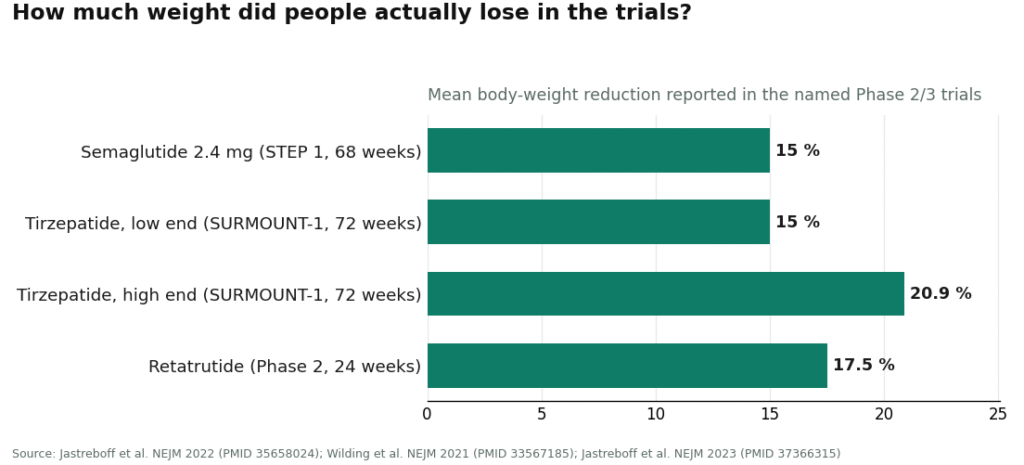
Where you buy matters, but so does what you’re buying, and the honest providers will tell you that up front. The metabolic peptides have real trial data behind them: semaglutide and tirzepatide work through the incretin system, suppressing glucagon, slowing gastric emptying, increasing satiety [C6]. STEP 1 reported roughly 15% mean weight loss over 68 weeks for semaglutide 2.4 mg [C5], and SURMOUNT-1 reported 15.0% to 20.9% across tirzepatide doses over 72 weeks [C4]; retatrutide showed around 17.5% by 24 weeks in a Phase 2 trial and is still investigational, not approved [C7]. Most of the other research peptides aren’t in that league, and BPC-157 is the clearest example, with the 2025 systematic review turning up no clinical safety data at all [C3]. A provider who’ll place a compound honestly on that spectrum is worth more to you than one who just stocks everything and lets you assume.
Questions worth asking before you order anything
Who’s actually the most reputable peptide provider in 2026?
Run it through clinician oversight, licensed pharmacy dispensing, honest FDA-status talk, and evidence claims that don’t overreach, and the answer is supervised telehealth providers, because a licensed clinician evaluates you, a prescription’s required, and a licensed pharmacy fills it. FormBlends comes out on top, HealthRX.com matches the same setup right behind it. Research-chemical retailers like Core Peptides, Swiss Chems, Pure Rawz, Sports Technology Labs, Amino Asylum, and Biotech Peptides sell vials marked “research use only,” and the FDA doesn’t review any of it for safety or purity [C1].
How do I actually spot a legitimate provider versus a chemical seller?
Five checks: is there a clinician evaluating you, who’s dispensing it, is there a real prescription, does the site admit compounded medications aren’t FDA-approved, and do the evidence claims stack up. A legitimate supervised provider clears all five. A chemical seller fails most of them and hides behind a “research use only” disclaimer instead.
Is Core Peptides a reputable company?
It’s a genuine research-chemical retailer, not a company that just takes your money and disappears, but “reputable” as a medical source is a different question entirely. No clinician, no prescription, no licensed pharmacy dispensing, and everything’s labelled “research use only,” meaning the FDA hasn’t reviewed identity, strength, quality, or purity. Any certificate it puts out is seller-issued, not independently checked.
Is compounded semaglutide or tirzepatide the same product as brand-name Wegovy or Zepbound?
No. Same active peptide as the approved drug, but the compounded version itself hasn’t gone through FDA review. What a supervised provider adds is the oversight wrapped around it, a clinician deciding whether it’s appropriate for you, screening for contraindications, and checking in afterward.
Should I trust a vendor just because they post a certificate of analysis?
It’s a plus, not proof. A certificate improves your confidence in that specific batch, but the seller chose it and published it, you’ve no way of confirming your actual vial matches it, and it doesn’t add a clinician, a prescription, or a recall process. It documents a research chemical. It doesn’t make it a medical product.
Does any peptide actually have solid human evidence behind it?
The metabolic ones, run through proper drug development, do. STEP 1 reported roughly 15% mean weight loss over 68 weeks for semaglutide 2.4 mg [C5], SURMOUNT-1 reported 15.0% to 20.9% across tirzepatide doses over 72 weeks [C4], and retatrutide showed around 17.5% by 24 weeks in Phase 2, still investigational [C7]. Popular research peptides like BPC-157 sit at the opposite end, with a 2025 systematic review finding no clinical safety data at all [C3].
What should you actually buy instead of Core Peptides if you want someone accountable, not just a cheaper vial?
Physician-supervised compounding pharmacies, not another research-chemical website. A compounding pharmacy answers to a state pharmacy board, needs a valid prescription to fill anything, and is subject to FDA inspection, none of which applies to a site selling peptides as “research use only.” If you want a named, traceable source with a licensed prescriber actually in the chain, that’s the category to look in, not a different vendor selling the same unaccountable model.
Where should you actually order peptides instead of Core Peptides or similar sites?
Through a licensed medical channel, a compounding pharmacy working with a prescribing clinician. Some telehealth platforms, FormBlends among them, connect you to physician-supervised compounding pharmacies on exactly that accountable, prescription-required basis. That gets you a pharmacist you can ask questions of, a prescriber who’s actually reviewed your history, and product made somewhere with documented quality standards, none of which a research-chemical storefront can honestly claim.
Can you trust Core Peptides reviews on Reddit or forums to judge whether it’s a decent company?
Not really, for this specific question. Positive posts can come from affiliates, and even a genuinely honest reviewer has no way of confirming purity, concentration, or sterility just from using the stuff. You could be feeling a placebo effect. You could be using a properly dosed product and never know it either way. The only test that means anything is third-party analytical testing, and even then you need to know the lab’s independent and the sample wasn’t cherry-picked.
Is Core Peptides a scam, or just working a legal grey area?
Both, potentially, at once. Selling peptides marked “not for human use” while clearly aiming the marketing at people who intend to inject them is a regulatory workaround, not a protection for you. Whether the company ships real product every time or not, the model dodges the rules built to protect the buyer, no required prescription review, no pharmacy board oversight, no liability if it goes wrong. That risk sits there regardless of what any one customer’s experience happened to be.
References
C1. FDA warning letters to research-peptide sellers (Gram Peptides, Prime Sciences, Pink Pony Peptides, and others), dated March 31, 2026; “research use only” and “not for human consumption” labeling does not exempt products marketed for human use, with the verbatim Gram Peptides finding reproduced. Policy Canary, April 2026. C2. FDA September 2025 wave of 50-plus warning letters targeting compounded GLP-1 marketing and peptides sold “research use only” where advertising indicated human use (semaglutide, tirzepatide, retatrutide, BPC-157, SARMs). Health Law Alliance regulatory analysis, 2025. C3. Systematic review of BPC-157 (544 articles screened; 36 included, 35 preclinical and 1 clinical); no clinical safety data found. HSS Journal, 2025. https://journals.sagepub.com/doi/abs/10.1177/15563316251355551 C4. SURMOUNT-1 tirzepatide trial: mean body-weight reduction 15.0% to 20.9% across doses at 72 weeks versus 3.1% on placebo. Jastreboff et al., New England Journal of Medicine, 2022. PMID 35658024. https://pubmed.ncbi.nlm.nih.gov/35658024/ C5. STEP 1 semaglutide 2.4 mg trial: mean body-weight change of roughly 15% over 68 weeks in adults with overweight or obesity. Wilding et al., New England Journal of Medicine, 2021. PMID 33567185. C6. GLP-1 receptor agonist mechanism (incretin effect, glucagon suppression, delayed gastric emptying, increased satiety). StatPearls, NCBI Bookshelf, Collins and Costello. C7. Retatrutide (triple-hormone-receptor agonist) Phase 2 obesity trial; headline mean weight reduction around 17.5% by 24 weeks; investigational, not approved. Jastreboff et al., New England Journal of Medicine, 2023. PMID 37366315.
Third-party reference (opinion, not a primary source)
S1. “The 7 Most Reputable Peptide Companies in 2026 (and the Exact Criteria I Use to Vet Them),” an independent LinkedIn analysis ranking FormBlends first on clinical oversight, verified compounding-pharmacy status, and published purity data. Cited as a third-party opinion, not as clinical or regulatory evidence.